Framework Overview
You are here:
The Psychology for Escorts Mechanistic Model
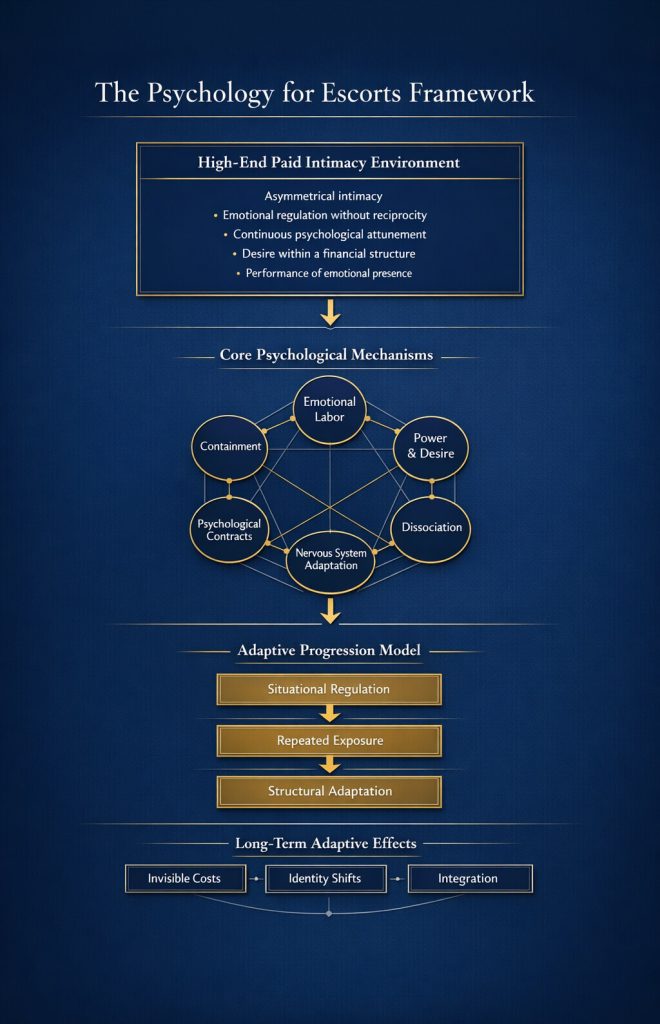
The Psychology for Escorts framework explains how repeated high-end paid intimacy shapes emotional regulation, relational organization, and identity over time. Rather than approaching escort work through moral or crisis-based narratives, this model defines it as a distinct psychological environment that generates predictable adaptive responses.
The framework is organized across two interconnected layers:
Core Psychological Mechanisms — regulatory processes operating within each interaction
Together, these elements explain how adaptation develops and what it gradually organizes.
01The Core Psychological Mechanisms
Within repeated paid intimacy, a small set of psychological processes regulates how the body and mind sustain functioning over time.
There are six core mechanisms that operate repeatedly — session after session, interaction after interaction.
Together, they support emotional stability, professional presence, and continued functioning within asymmetrical intimacy. They are not occasional stress responses, but adaptive regulatory systems that gradually become the nervous system’s default mode within the work context. Below are the six core mechanisms shaping the inner experience of escort work.
A dynamic system in which money structures access and desire concentrates emotional pressure.
Holding emotional intensity and desire without absorbing or expressing it.
Elective distance that allows presence without full emotional immersion.
Repeated exposure gradually trains regulation toward efficiency rather than depth of feeling
Implicit internal agreements that organize boundaries, emotional distance, and what must be regulated in order to remain stable over time.
02The Adaptive
Progression Model
While core mechanisms operate within each interaction, repetition determines their long-term impact. The Adaptive Progression Model explains how situational regulation gradually becomes structured adaptation. What begins as flexible emotional management increasingly becomes automatic organization.
With continued exposure:
• regulation becomes faster and more efficient
• protective patterns stabilize
• adaptive responses generalize beyond the work context
The model maps increasing likelihood — not fixed outcomes — showing how repeated emotional environments train the nervous system over time.
03Long-Term Adaptive Effects
Long-Term Adaptive Effects as structured regulation remains active across months and years, adaptation begins to shape everyday emotional life. What once operated primarily within work contexts gradually becomes the nervous system’s default mode of regulation.
This process influences:
• emotional range
• intimacy and closeness
• stress responses
• relational patterns
• sense of self
The long-term adaptive effects describe the cumulative psychological outcomes that emerge when adaptation becomes embedded in daily functioning.
The gradual physiological and emotional strain that arises when regulation becomes constant rather than situational.
How the Framework Functions as a Whole
Core mechanisms explain how stability is maintained within paid intimacy.
The progression model explains how repeated regulation becomes structured over time. Long-term adaptive effects explain what that structure gradually produces.
“These experiences are positioned not as breakdown but as coherent biological learning.”
- Why emotional distance can feel natural
- Why fatigue may appear without physical cause
- Why intimacy outside work often feels different
- Why adaptation often becomes noticeable only later
- Sense of self within intimacy
The purpose of the framework
- Establish paid intimacy as a legitimate psychological environment
- Map adaptation rather than diagnose damage
- Explain regulation rather than label dysfunction
- Replace misinterpretation and self-doubt with mechanistic understanding