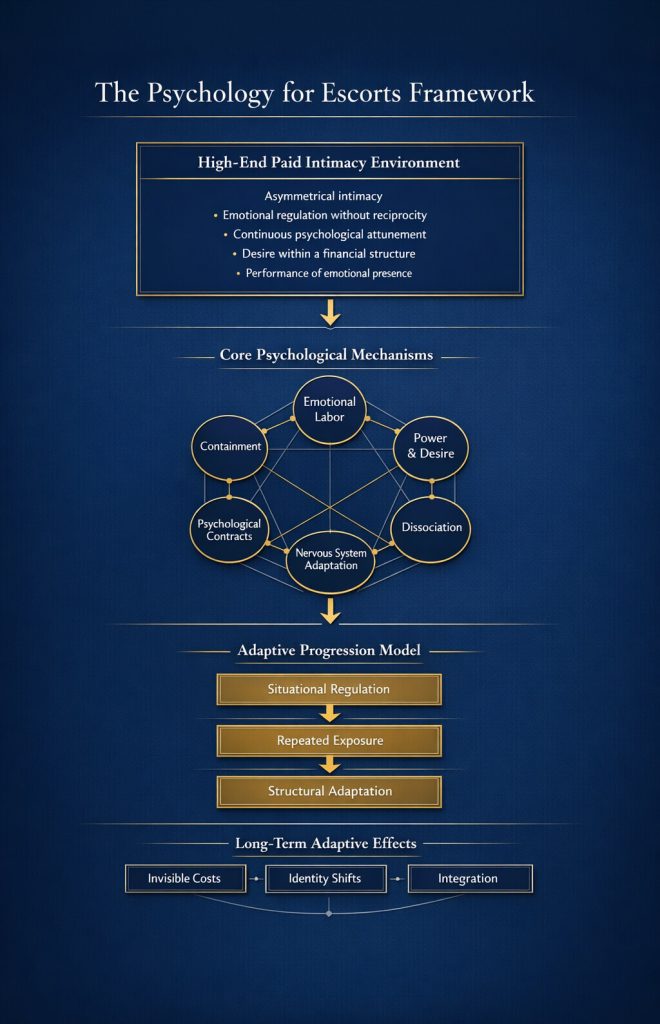
Psychology for Escorts is a psychological framework developed to explain how repeated emotional regulation and nervous system adaptation gradually shape intimacy patterns and identity over time.
High-end escort work does not only influence lifestyle, income, or social position. It reorganizes emotional regulation, nervous system responses, and relational patterns through repetition. Most women notice these shifts long before they can name or understand them. This platform exists to make those mechanisms visible and intelligible.
What High-End Escort Work Actually Demands Psychologically
High-end escort work is not defined by sex alone. It is defined by repeated intimacy within asymmetrical emotional conditions.
“These are not abstract concepts. They are lived, embodied regulatory processes”
The Framework
The Psychology for Escorts Framework
This framework was developed around one central principle: What is not consciously understood becomes automatically organized biologically.
It integrates emotion regulation science, nervous system physiology, dissociation as protection, relational dynamics, and power–desire mechanics to explain how paid intimacy shapes psychological functioning over time.
Why This Platform Exists
Most existing psychological narratives around escort work are moralized, romanticized, simplified, or crisis-focused. Psychology for Escorts was created to offer a mechanistic understanding instead.
Not to judge the work. Not to promote it.
But to explain what repeated high-end paid intimacy tends to organize within the nervous system, emotional regulation, and identity over time.
Clinical Work
For women who wish to work clinically with adaptive patterns that developed through escort work — including emotional regulation, distance, dissociation, intimacy fatigue, or identity shift — specialized psychological treatment is available. Clinical work is offered via Psychologist for Escorts
Behind every interaction in high-end escorting, a small set of regulatory mechanisms operates continuously — shaping emotional experience, nervous system responses and entity over time. These include:
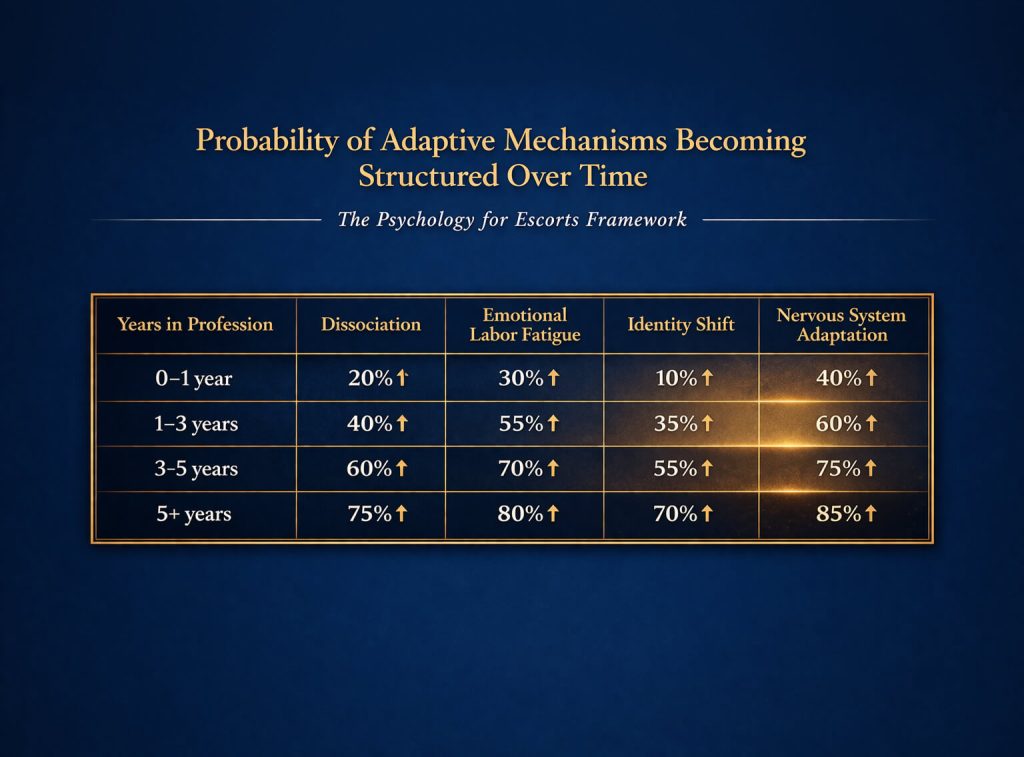
With repetition, emotional regulation in high-end escort work begins to organize the nervous system itself. What starts as situational response gradually becomes structured adaptation. Early regulation remains flexible and context-dependent. With continued exposure, responses become faster, more efficient, and more automatic. Over longer durations, these patterns are increasingly likely to generalize beyond the work context — shaping emotional life, relationships, and identity.
“The model does not describe fixed outcomes. It maps increasing likelihoods of biological adaptation over time.”
As repeated emotional regulation becomes structured within the nervous system, its influence gradually extends beyond the work context. What once functioned as situational regulation begins to generalize. Patterns that were activated during sessions increasingly shape everyday emotional life.
“This shift does not occur suddenly.
It unfolds progressively.”
Over time, emotional labor, containment, dissociation, and efficiency-based nervous system regulation begin organizing emotional responses, relational dynamics, and sense of self. What is practiced repeatedly becomes the system’s baseline.
Long-term outcomes vary. Some women experience minimal change. Others notice pronounced adaptation. Both reflect normal biological learning shaped by duration, intensity, recovery capacity, and individual sensitivity.
the restoration of flexibility as protection becomes responsive to context rather than automatic.
This Is Not Pathology It Is Adaptation
The Psychology for Escorts framework does not frame these adaptive patterns as trauma, weakness, or failure. They reflect predictable nervous system learning under repeated emotional demand.
This perspective reframes experiences such as emotional distance, numbness, or shifts in intimacy as adaptation rather than damage.
“Nothing was lost. Regulation was learned.”
“Psychology for Escorts is not a service. It is a psychological model.”
About the Author
Psychology for Escorts is a psychological framework developed by Eva Valora a licensed psychologist specializing in the psychological mechanics of high-end paid intimacy, nervous system adaptation, emotional regulation, and relational dynamics. Through sustained clinical application, professional practice, and extended real-world observation within high-end paid intimacy contexts, recurring adaptive mechanisms were identified, mapped, and refined into a coherent mechanistic model.
The framework reflects the integration of psychological science, clinical experience, and long-term pattern recognition across women working in high-end escort environments.
Formal training in psychology, including organizational and occupational psychology
Specialized clinical work in sexual psychology and relational functioning
Long-term therapeutic practice with individuals navigating intimacy, regulation, and identity shifts
Direct experiential knowledge of adaptive strategies, identity navigation, and psychological cost within high-end escort environments
Direct longitudinal observation of adaptive patterns within high-end escort environments over a decade
Multidisciplinary expertise integrating nervous system regulation, somatic awareness, and embodied emotional processing
“Psychology for Escorts is not a service. It is a psychological model.”
About the Author
Psychology for Escorts is a psychological framework developed by Eva Valora a licensed psychologist specializing in the psychological mechanics of high-end paid intimacy, nervous system adaptation, emotional regulation, and relational dynamics. Through sustained clinical application, professional practice, and extended real-world observation within high-end paid intimacy contexts, recurring adaptive mechanisms were identified, mapped, and refined into a coherent mechanistic model.
The framework reflects the integration of psychological science, clinical experience, and long-term pattern recognition across women working in high-end escort environments.